Showing posts with label Wine. Show all posts

Monday, August 15, 2011

The Spina di Rosa Bottle is Empty


Aw, this picture is sad:
Though drinking this lovely rose’ from Donini winery was delicious (and, as a model of restraint, I drank it slowly over a few days), it was our last bottle. We were lucky enough to ship a box of Donini wines back (thanks to Keith and Tasha for the assist), and while we still have a bottle of frizzante white Brigante, this is it for the Spina di Rosa. That empty bottle is almost a reason to go back all on its own.

*Note: We were on pre-tirement, and now we’re back. Want the full story? Start the pre-tirement journey here. Want to go backwards? Read the last pre-tired post here and scroll back. Or, just keep coming back for pretty Italy pictures.

Saturday, April 23, 2011

TTITIM #4: Diego and Donini Wines

The last few hits (coming in the next few days) in my Top Ten Italian Things I’ll Miss list (you can see all TTITIM here, and catch up more on the reasons and explanation behind the list) are ones that I’ve mentioned a few times at least already on the blog (unlike a couple below that I missed posting up on earlier), and ones that were central to our pre-tirement in Italy. Starting with our now-friend Diego, the owner, vintner, and driving force behind Donini wines. I’ve talked a lot about both the wine-maker and the winery (read another Donini blog here, or read some on my cocktail blog), with good reason: the wine-maker has been incredibly welcoming to us, and the wines are delicious and have been a perfect liquid accompaniment to many meals and snacks. We’ve stopped at the winery, say, 20 times, and have taken most visitors there, too. Each time, Diego has taken us around the winery (different rooms every time it seems--it’s a good-sized place), and we’ve gotten to take many tastes straight off the casks (once even tasting a certain wine three times--once a version aged a year, then the same aged two years, and then bottled and aged longer), as you can see in this pic of Diego and Nat:
Diego, as you can tell if you take the time to talk a bit (he loves to talk, and has English skills that are much better than he thinks), loves making wine, and loves making wine that people can drink enjoyably (there’s no snootiness at Donini, unlike most wineries, and no hard sell, either, which is refreshing), daily. I just wish some importer on the west coast would start bringing in Donini wines for more people in the US to have--or just for us to have. One final Donini pic I don’t believe I’ve posted before, the room way in the back, the original room of the winery, where the big wood casks are:
Here’s a final toast, Diego, thanks for keeping us in good wine and being a good friend.

*All TTITIM

Monday, April 11, 2011

Pizza at Bar Fizz

I know I’ve mentioned Bar Fizz (aka, Restaurant Guliano) a number of times here, but it is our local eatery, and one we love, and one that’s owned by a swell Italian fella, and because of all this I feel I should mention it as much as possible—not to mention that we eat there about once a week. Enough, really, that I feel I’m a Fizz-icist (ba-dump-bump). Also, I haven’t (what’s wrong with me?) had any pizza pics here on the Six Month blog lately, so call is Fizz-met (ba-dump-bump again). Our Fizz evening started with a pitcher of the vino Bianca al Spina, or the white wine off the tap. It’s a lovely light crisp frizzante wine that even looks good in low light:
cause we’re hungry (and cause we hadn’t had it in a while) we started with a shared spaghetti al pesto, which (as usual) was great, with the pasta cooked just right and the sauce fresh and not overwhelming:
Then (and this is some sort of a modern Italian miracle), we had pizzas, and neither of us had our favorite (which Nat created): Quattro formaggi con cipolla. Instead, I had the Siciliana, senza acchuighe (or without anchovies). Pal Tasha had this first way back when, and she dug it, and I dig it too: peppers, onions, and salty delicious capers:
Nat went for another regular in our Fizz pizza, the Vegatariana (sense olive—neither of us totally dig the olives in their non-oil form), which has artichokes, mushrooms, onions, and peppers and a heaping helping of awesomeness:
You probably know us well enough by now to guess that we didn’t skip dessert. And if you’ve read this blog for a bit, you can guess what we had (cause I wrote a whole post about it): big tartufo with brandy. Go read about it, cause I was too full to take any more pics. Another smashing night at the Fizz (dang, I’ll miss having it so close).

*See more Italian restaurants: Capponi, Nestor's,Nonna Gelsa, Le Capannine di Sommavilla, Calagrana, Trattoria Il Saraceno, L Enoteca Wine Club, Mastro Dante, Bar Fizz, Da Cesari, al Frantoio, La Balestra, Lo Strattoio, Mencuccio, La Fortezza. La Tufa, Kentia Pizzeria, Il Feudo del Vicari, Buca di Bacco, Camino Vecchio, Quattro Leoni, Ottavius

*See all Italian restaurants

Saturday, March 19, 2011

Now This Is an Italian Party

Check out this cask—wouldn’t you love to have everyone you know over some Saturday afternoon in late June and start pouring? Provided the wine was delish (and you have to imagine it would be), and provided you had some thirsty friends, it would be a memorable evening, cause that cask holds 40,000 liters:
It’s actually the Botte dei Canoncini, residing in Gu-Gu-Gubbio, and dates back to the 16th century. So, you’d have some stories to tell around it while having said party in June. Vino grande!

Sunday, March 13, 2011

Five Pictures of Orvieto*

I can admit it—I have a fair share of what I like to call “punk-rock-poopy-pants-ness.” By this, I mean I often rebel against things (songs, places, books, movies, foods, shoes) that seem giantly mainstreamily popular. Usually, once I do get around to the thing, or at least 50% of the time, I’m sad about my previous poopy-pants-ness. But hey, as Popeye says, I yam what I yam. Orvieto falls into the “thing” category above, as we’d never visited it in all our trips to central Italy, until a couple weeks ago, even though it’s one of Umbria’s top tourist stops (in the top three with Perugia and Assisi I suppose, with maybe Spoleto a trailing fourth), and its Duomo one of the top two (with the Basilica of St. Francis) un-miss-able spots in Umbria for those interested in art. So, basically, I was kicking myself in the pants by my poopy-pants-ness. However, when pals Jon and Nicole said they were coming to visit we wanted to go somewhere new and so I got over myself and suggested Orvieto. The Orvieto experience starts (if you’re smart) by parking at the bottom of the tufa (or 325-meter-tall volcanic mountain) that Orvieto proper is built on (and which a town of some sort has been on due to its tall and fortuitous position since the Bronze Age) and taking the funicular up the mountain, through the forest, and then into Orvieto’s Rocca. Provided that you don’t head-butt the funicular heading down:
Next to where the funicular stops once you’re up up up the hill (around the corner more-or-less) was our first stop: the Pozzo di San Patrizio (or well of St. Patrick)—a good first stop especially if you’re going towards it when the large student groups are walking away from it. Named after the Irish saint who died in a cave, the well was built for Pope Clement the seventh, who fled Rome (dressed as a grocery store manager—I see him in a Safeway smock) and settled into Orvieto, worried about running out of water in an attack he felt was imminent. The well’s size is a marvel, especially considering the date it was made: 62 meters deep and 12 wide. But the real marvel is the double helix design, created to provide people and their donkeys with a path to walk both up and down without having to worry about meeting anyone going the opposite direction. Throughout the walk down, large, deep windows are cut, allowing natural light to filter to the 248 steps:
From the well, we wandered to the main event, the Duomo. It was built (well, the more entertaining story is what I’m going to tell--there might be a separate, more political story, but it’s not as much fun) after the same old story: boy becomes priest, priest starts to question his faith, specifically his faith having to do with the host (or, for non-church-oriented folks, the wafer and wine given with communion) being the actual body of Christ every time (through the miracle of transubstantiation), until, during a service, the host starts to bleed, getting on him and his liturgical table linen (or corporale), with each stain of blood assuming the face of Christ. You know, that old story. So, the Duomo in Orvieto was built (after this miracle was okay’d by the pope naturally) to house the corporale relic, starting in 1290 and finishing some 300 years later. The site was originally an Etruscan temple, then the first duomo, and it sits high in the center of town. And it is a masterpiece, almost too difficult to even take in without a few gasps of breath. It’s even hard to photograph (the massive façade, that is), but I suggest going to track down a few wide angle photos (or just getting away from the computer and going to see it), since this one only catches the top half, which is covered with mosaics:
Farther down, the four pillars are covered in intricate carvings, Biblical scenes, saints, stories, and local folks. Some of the carvings are frightening, too, with a ferocious Cain braining Able once again, Adam and Eve cowering as God drives them out of the Garden, and a whole pillar whose bottom details (after passing through Paradise) a chilling and creepy hell and purgatory where people are being pulled by devils:
and look at the detail—amazing:
One more friendly (or at least balancing) aspect is that wine vines wind around all the sculptures (on this pillar, at least) in all the levels. This is probably more of a shout out to Orvieto’s famous white wines (that volcanic soil isn’t just good cause it’s called “tufa” and fun to say—it also provides a perfect breeding and cultivating ground for white wine grapes), but I found it nice that the sculptures were providing the sinners with a little wine while they were being tormented. The Duomo is built out of the same dramatic black and white marble as many other large churches in central Italy, and hosts a number of intriguing statues on the outside even away from the façade. With this said, don’t think the inside isn’t magnificent though—I just don’t have any photos, cause they ask you not to take them (though there was one particularly jack-ass-y American in there who thought he should have the right to take photos wherever he wanted). Inside there are a number of fine pieces spread around the church, though it seems a bit sparse at first glace. The hits come especially in the Capella di Corporale (where the above-mentioned relic is held) and the carvings around the massive organ (okay, get those chuckles out, I just said “massive organ”), and even more especially (is that proper? I’m still chuckling) in the frescos by Luca Signorelli in the Capella di San Brizio. This chapel is, well, fantasmagorically outstanding. And I’m not the first to say it (big man Michelangelo himself studied it well before he painted a little thing called the Sistine Chapel. So there). The subject of the Frescos is the Last Judgement, and they take a lot of their vigor and fantastic temperament  from Dante’s work (there is one fresco of Dante, along with Ovid and others, and specific scenes from the Divine comedy done on the lower level as well). Specific panels include the preaching of the Antichrist (picture a devious-eyed Christ preaching as atrocities happen), the rising of the dead, end of the world, Purgatorio, Paradiso, and the calling of the saved. In all the pictures, the figures are muscular, often contorted, often in great pain (being ridden around by devils, or rising whole from the ground), and always hard to look away from. Okay, that was heavy, but it is quite amazing, as is the whole Duomo, including this dog who looks a bit hungry from his perch high above the ground:
There is much more to see in Orvieto, but like the dog above, we were hungry enough, and had seen so much after the Duomo’s vast treasures that we headed off in search of a good, long, Italian lunch, and some of the much-talked-about Orvieto wine. Cause you can’t make it through a day on history and art alone (at least you can’t if you’re traveling with me, that is).

*Okay, there are six pics. But one's a close up. That shouldn't count against me.

Sunday, December 19, 2010

Watching Wine Making at Donini

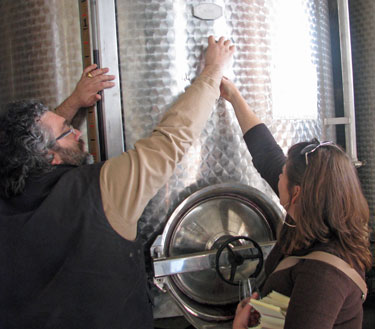
We stopped by Donini the other day (Donini being the local winery I’ve mentioned at least once, and probably much more, and which I wrote about in more detail in this Donini post on Spiked Punch) to pick out some wines for sending home for the holidays (we’re not going home, but thought sending some wine home would balance out us missing spending the holidays with family and friends, especially cause we love the Donini selection). While there, we also picked up some of the other gift items for ourselves and the holidays (they have an amazing selection of other wines, chocolates, truffle products, rums, and more—the four things we got I just listed). Shopping and shipping was great, naturally. But even better was that Diego (the amazingly friendly vintner and owner of Donini) was there and took us back into the winery itself so we could see a bottling in progress. In the back room, there are huge vats and containers full of wine in various stages:
And across from them, there’s a giant machine that the Donini crew shepherd the wine through when it’s ready (this is Diego in the picture, too, by the way):
On one end of the machine, there are loads of bottles ready and waiting for wine (isn’t it interesting how melancholy empty bottles look?):
The bottles get cleaned, get instructions on how to hold their wine (all-right-y, I made that up), and then get filled—but not without a lot of corks in place:
The corks then come into play on the line, in a very cool corking and sealing area, which is an example of robots being used for good and which can be a little hot:
That day they were bottling the 2008 Sangiovese and we got to taste it right from the tap (no picture here—I was too busy sampling). It was delightful even without spending any time in the bottle, a full, dry-but-full-flavored, wine. We’d been drinking a lot of the bouncy vino nouvo called Bindolo, a fresh fruity number that is right off the vine (more-or-less), which we’ve loved for its naughty boy out of school nature. The Sangiovese is a dandy counterbalance, a more adult wine (and one ideal for the colder holiday season). I think we must have outwardly shown our appreciation of the wine, and of the care that the Donini folks put into their wine, because Diego sent us home with a bottle of the 2008 right off the line—it doesn’t even have a label yet (you’ll have to trust me that I didn’t just bottle it myself):

Thursday, November 11, 2010

Arezzo Antique Market and Lunch at Trattoria Il Saraceno

On the first Sunday and the preceding Saturday of every month, the city of Arezzo hosts an antique market, which we’d heard was the “grande dame” of markets. Of course, we wanted to visit as soon as possible, so last Saturday we decided to head out and get our market on (we’d been to a number of markets already, but heard this was different). But we had a double reason for heading to Arezzo—our pal Lora (married to pal Jim) from Chicago had told us that her cousin owned a restaurant in Arezzo, and we wanted to visit there as well.
Arezzo is a pretty large spot, about an hour from us on the way to Florence. It’s a very old city, and at one time was a decent power in the Italian city-state landscape, warring with Florence and Siena, if never quite as much a player as the former. Also, it was home to some good artists, including Vasari (who wrote the Lives of the Painters as well). Today though, it’s a contradiction. The inner, old city (which we’d never spent much time in previously) is lovely, but it’s surrounded by apartment buildings (some that are downtrodden and crumbly) and strip malls and shopping centers (we’d had to drive through the outskirts numerous times, and hadn’t enjoyed it in the least). Today, we wound around the outskirts and a ton of traffic before scoring a parking space right on the edge of the centro. We walked up the first street we came to heading in, a street covered with booths for the market. At first, we thought the market was on this street only, but we were completely wrong: the antique market spread through most streets in the old centro, emanating from the Pizza Grande (which itself was packed with antique-ers):
The wares for sale covered a wide range: really nice old furniture, pricey paintings and other art, books from many years past, lines, porcelain sculptures, jewelry, and more. One thing was consistent with about 95% of the antiques. The pricing, which was fairly high. This was streets of genuine, collectable, antiques. Sprinkled within were, like at a good antique market anywhere, less pricey artifacts and smaller treasures, and we browsed for quite a while, but then realized it was lunchtime, which meant time for us to stop at Trattoria Il Saraceno. Lora had told us to ask for Virgilio and/or Olga, her relatives:
Once we grabbed a cozy table in the corner, we asked about Virgilio and Olga, but it turned out only he was in for lunch. He came by and was a very kindly, affable Italian gentleman. Even though he didn’t speak much English, and our Italian is still coming along, we talked for a bit, and then we broke out the “we’re vegetarians” admitting, and he walked through what we might like for lunch. While waiting for lunch, we looked around Il Saraceno, which was pleasant and welcoming and boasted maybe the biggest jar of biscotti I’d ever seen:
While weighing out food we had ordered a glass of rosso neuvo, or new red wine. It was very fresh, both on the tongue and in how it was bursting with flavor—a great accompaniment to lunch (and the second glass was great with the end of lunch). Nat had a bit of the mysterious look to go with the bright wine:
We started with an amuse bouche (well, it seemed much like one, in that it was brought to us even without ordering, and was an incredibly tasty way to get started) of some spinachi bruschetta, and then moved on to our main (we both had the same), polenta funghi. I’d been craving polenta for weeks, but hadn’t been able to track down a veggie version yet. This was delicious polenta too, creamy but without losing the texture, and with juicy mushrooms in the middle. Very good, and very warming (it’d been a chilly morning, though the sun was out by the time we left lunch):
As you can see, I cleaned that polenta right up:
We also had an array of Contorni (or side dishes, or post main dishes) after our polentas. For me, an ensalata mista and some really nicely roasted potatoes with strings of fennel and roast garlic, and for Nat, fagioli pomodoro, or beans in tomato sauce, which she topped (as I did the potatoes) with green fresh olive oil:
We also met some friendly Americans from Denver who were sitting at the next table, and who had been staying outside Cortona for a month. Sadly, I forgot (or forgot to ask) their names, but if they happen to read this, thanks again for the great restaurant recommendations. After eating we were ready to hit the market again, this time with an eye on unearthing some bargains. Nat may have made the best find with her chic ruffled long coat (which looked almost like something Vince Noir would wear), but I was pretty happy with the 1950 Cynar add I uncovered, and the antique medical instrument (she’ll have to tell you what it’s for) Nat discovered was cool as well:
If you get the chance, stopping by the Arezzo market is well worth checking out, even just to browse. Just be ready to deal with the city traffic, and be sure to put Trattoria Il Saraceno on the plan for lunching or dinner-ing.

*See more Italian restaurants: Capponi, Nestor's,Nonna Gelsa,Le Capannine di Sommavilla, Calagrana

*See all Italian restaurants

Thursday, October 28, 2010

Valerie, Mike, Spello, Wine, and the Small World

If you don’t know it, I write books in the cocktail-home-entertaining-food-poetry arena (hey, since we’re here, let me give a plug: buy my books). For most all of the books I’ve been extremely lucky in that my editor has been a genius named Valerie Cimino. She’s had a major hand in shaping every book we’ve worked together on, with fantastic ideas and guidance from the first page to the last. She’s also a big Italian-ophile, and won’t shy away from a good cocktail (or good wine), which isn’t the only reason we’re pals beyond the working relationship, but doesn’t hurt, either. Sometime in late summer, when working on a book (that comes out next fall--keep your eyes peeled), we realized her and her husband Mike were planning on an Italian vacation during the dates Nat and I were pre-tiring here. Once we knew the dates were matching up on the calendar, we decided lickety-split to meet up for a long lunch, some good conversation, and some catching up, all of which happened last week, in a lovely  town called Spello (after a side trip to a town called Cannara, which had no restaurants open for lunch, weirdly—but like many near misses on a journey, the miss ended up working in our favor).

Spello is sorta in the middle between our home in the Niccone valley and Trevi, where Val and Mike were staying, about 45 minutes from us and 20 from them. This was great for Nat and I, as we’d mostly stuck in our area so far. Spello is an Umbrian hill town that’s very picturesque, with sun-dappled streets (does anyone say “sun-dappled” anymore? They should):
but a town definitely on the tourist trail (it’s near Assisi, which is a big stopping spot--and even more beautiful), which means more locals speak English and that there are more shops angled at tourists, which is unlike our neighborhoods. We just parked at the bottom of the hill Spello’s on, and then walked up, deciding to choose a lunch spot at random. We were about halfway up, near a lovely church with a sorrowfully austere metal horse in front of it:
when we noticed Enoteca Properzio (an Enoteca is a wine shop, most of which also have light lunches). We were checking out the menu when a very friendly woman working there came out and started talking to us, and coaxed us in--it was a very cozy place, lots of old brick work and wine everywhere, but with a lot of modern touches, too (but not so many as to be annoying). We sat down and picked our lunches and were talking to our friendly waitress (the one who spoke to us on the way in), and she brought over the owner, Roberto Angelini. He doesn’t speak English, but was extremely friendly and debonair in an older Italian man kind of way. It turns out (the waitress is translating) that he travels around the U.S. once a year doing wine tastings and wine selling and dinners, going to NY, Chicago, LA, other cities, and Seattle. Once he found out Nat and I were from Seattle, he got very excited, and somewhere in his fast-Italian talking mentioned Amazon (Nat heard it, not me at first), which if you don’t know is where I worked for eleven years, mostly in the Kitchen Store. I naturally mentioned this fact (hey, it was a big part of my life, and I’m proud of the work I did there, even though I’m pre-tired now), and then he got really excited and mentioned “Jeff.” I thought (as one would) that he meant the big laugh and big boss himself, Jeff Bezos. He then went back to his desk and got this big folder (turns out it was a big sheaf of wine orders) and on the front it said “Jeff Wilke,” who was my bosses bosses boss (which sounds more remote than it was) at Amazon. I guess he and a few other Amazon folks had stopped by (this Enoteca is somewhat well known for its extensive wine selection and charming staff) and made friends with Roberto, and ordered lots of wine--Jeff may have even hosted him back in Bellevue--we were talking pretty rapidly so I may not have caught everything. This is quite an aside, but I just think it’s amazing how the world catches up with you in the strangest places. Here is Roberto and our friendly waitress (so you’ll know them when you stop by--which you should, if you like wine):
The wines we had, as well as the food, at Enoteca Properzio, were first rate. We ended up bringing home a couple memorable bottles, including a light flavorful white called Renaro (which was a combination of Pinot nero, Pinto grigio, and Pinot bianco grapes, and which would go well outside under the sun with cheese and honey, honey) and a dry, rich red called Rosso Assisi Riserva (from 1997, and being “Riserva” made from the best of the best, and all Sangiovese grapes, and sure to be a hit at a dinner with serious spices in play). Look for them at your local wineshop or online.

In my mind though, the best wine doesn’t mean more than a cup of flat diet Dr. Pepper if you aren’t having it with friends and accompanying it with conversation and laughter. This afternoon, we were blessed (by some Italian wine deity I’m guessing) with having both good friends and good wine. The best possibly afternoon, and when the fact that it took place in an Umbrian hill town is thrown into the equation . . . well, it makes for a mighty-fine pre-tirement day. Thanks again Valerie and Mike, for meeting up with us in Spello: