Wouldn’t it be a better world if the fountain below actually fountained out a stream of bitterly delectable brightly crimson Campari? Though, what if it does, one day a year? And people line up around the block (or up the street, as I think the “block” here is a mountain) for Campari straight out of the fountain? Dang, I wanna be there. However, I think it’s just (as I’ve heard) a fountain donated by Campari. But wow, a boy can dream Campari dreams when looking at this:
Showing posts with label Italian liqueurs. Show all posts
Friday, April 15, 2011
Monday, December 20, 2010
Dinner at Da Cesari in Bologna
Way back when, before we even made it to Italy, I wrote a little post on this very blog about how excited we were to be able to re-visit a restaurant in Bologna called Da Cesari (the post had a picture of their rocking ravioli). Well, we finally made it back (turns out, a two hour drive and many hour meal is a bit harder to schedule than one might think, due to having to find a watcher/sitter for Sookie and Rory. You’d think they might be able to stay home alone, but that kind of wild party might make landlords Andrew and Marianne give us the boot. Luckily, neighbor Doris was kind enough to watch over the pooches).
For a little more backstory, the last time we were in Italy (April, 2009), we stopped in Bologna. We’d never been before and thought it well worth checking out, and ended up really enjoying our stay in the city. The highlight (as you might expect) was the best meal we had while there, which was also perhaps the best meal we had that trip, a dinner Da Cesari. I detailed this meal in a Da Cesari post on Spiked Punch, and also rambled on more about a particular ravioli on Amazon.com’s Kitchen blog, Al Dente. At this first visit we also made friends with the second in command at Da Cesari, an outgoing and amazingly personable Italian gentleman named Gaetano. We’d stayed in loose touch with Gaetano since then, and he was great at helping us set up this most recent dinner and our latest trip to Bologna. Look how nice he is (especially when holding a big bottle of homemade mirtillo—or blueberry--grappa):
I could go on and on about how amazingly nice the whole crew that works at Da Cesari is (from Mr. Cesari himself to waitress Sylwia and even to past employee Veronica who we met after dinner), and how the restaurant is a Bologna institution that’s been there since the 1950s (started by the current Mr. Cesari’s dad), and how the region it’s in (Emile Romagna) is famous for its cuisine, and how sweet they treated us, but I know you want to get the spotlight shifted over to the edible attraction, so I’m going to cut the chatter (well, as much as I can--which, if you’ve read this blog before, know isn’t much) and get to the goods. We started with a glass of silver-hued Prosecco that matched the holiday decorations, but quickly moved on (not because the Prosecco was poor, mind you, but just because there was much more to be had) to the family Lambrusco, which was a true traditional Lambrusco from Castelvetro, dry and with mucho frizzante:
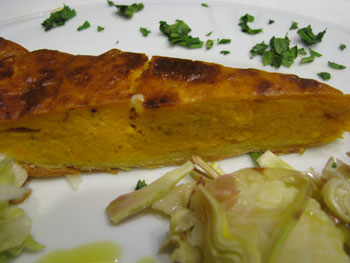
Another quick side note before getting to the starters: there is Da Cesari, the ristorante we’re at, as well as Cesari, the winery, which is run by Mr. Cesari’s brother (who I suppose is also Mr. Cesari). The ristorante is well-stocked as you would expect with the family-named wine, but you can also get Cesari wine in many spots worldwide, so look for it. Okay, don’t be jealous (well, a smidge is fine), but since we are pals with Gaetano, we somewhat managed a special set up of a menu, starting with a combo appetizer plate that was stunning. It featured Nat’s favorite pumpkin pie (which isn’t the traditionally Thanksgiving pie, but a creamy masterpiece with a thin flakey crust. It has the same melt-in-your-mouth-ness of a good sweet pumpkin pie, but is savory) alongside an artichoke heart salad that was topped with the finest salty parmesan in the world:
across from these two (as if they weren’t enough) were an ensalata of lettuce and radicchio (topped again with that legendary parmesan and a vinaigrette that had solid flavor but did nothing to take away from the taste of the ingredients) and an artichoke flan (sometimes called a sformatina). The flan, the flan was suave but with louder flecks of artichoke, giving it a great texture alongside the artichoke-y-ness, and it was topped with a creamy parmesan sauce that was rich against the worldlier artichoke:
After the plate of pure happiness that some might refer to as a “starter,” we were brought not one, not two, but three pastas apiece. Each would have made it a night to talk about, gastronomically, but the three together made it legendary (and again, thanks to swell fella Gaetano for making it happen). The first in line was passatelli. Passatelli is a traditional dish from the region, and one that was different than any pasta I’d ever had. It’s made almost completely from egg and parmesan with only a minimal amount of flour and bread crumbs, accented by freshly ground black pepper. The end result is a thicker, crumbly-er pasta, one that brings buckets of cheese flavor and the snap of fresh pepper to every bite (and one we’re determined to try and make, though Gaetano warned us that while it sounds simple, it takes years to perfect):
Following up the passiatelli was the reason, really (well, seeing Bologna again was up there, too) for coming back: the pumpkin ravioli. I’ve talked about it a bunch already, but let me assure you that it hasn’t gotten any worse. The pasta itself is still made and cooked to perfection, and the filling is still velvety and savory with pumpkin. This time I enjoyed it just as much as previously, but noticed another thing: the ravioli edges haven’t been smeared together to the degree where part of the pasta gets gummy. Too many raviolis have this problem, but look and you’ll see the edges are just in a state of introduction:
After the ravioli, you might dream that we’d be overfull, and not able to enjoy any more. Hah! Next came another scrumptious pasta: tortelloni con tartufo. I will never (I hope) be so full that I can’t fit in a serving of ricotta-stuffed tortelloni topped with fresh white truffles. The war between those who love black truffles best and those who love white truffles best is, like many of these types of food or booze wars, silly to me. My motto is “have as much of both as possible while the arguers argue in the corner.” The tortelloni were slightly chewy (the way you want them), the ricotta was rich and fresh, and the truffles were like tasting the finest earth ever imagined:
After the pasta triumvirate, there was only one thing on our minds: semi freddo. If you didn’t know (and as you might expect), semi freddo is semi frozen ice cream. Most are deliciously melty, but most servings of semi freddo don’t feature an almond speckled crust:
For a little more backstory, the last time we were in Italy (April, 2009), we stopped in Bologna. We’d never been before and thought it well worth checking out, and ended up really enjoying our stay in the city. The highlight (as you might expect) was the best meal we had while there, which was also perhaps the best meal we had that trip, a dinner Da Cesari. I detailed this meal in a Da Cesari post on Spiked Punch, and also rambled on more about a particular ravioli on Amazon.com’s Kitchen blog, Al Dente. At this first visit we also made friends with the second in command at Da Cesari, an outgoing and amazingly personable Italian gentleman named Gaetano. We’d stayed in loose touch with Gaetano since then, and he was great at helping us set up this most recent dinner and our latest trip to Bologna. Look how nice he is (especially when holding a big bottle of homemade mirtillo—or blueberry--grappa):
I could go on and on about how amazingly nice the whole crew that works at Da Cesari is (from Mr. Cesari himself to waitress Sylwia and even to past employee Veronica who we met after dinner), and how the restaurant is a Bologna institution that’s been there since the 1950s (started by the current Mr. Cesari’s dad), and how the region it’s in (Emile Romagna) is famous for its cuisine, and how sweet they treated us, but I know you want to get the spotlight shifted over to the edible attraction, so I’m going to cut the chatter (well, as much as I can--which, if you’ve read this blog before, know isn’t much) and get to the goods. We started with a glass of silver-hued Prosecco that matched the holiday decorations, but quickly moved on (not because the Prosecco was poor, mind you, but just because there was much more to be had) to the family Lambrusco, which was a true traditional Lambrusco from Castelvetro, dry and with mucho frizzante:
Another quick side note before getting to the starters: there is Da Cesari, the ristorante we’re at, as well as Cesari, the winery, which is run by Mr. Cesari’s brother (who I suppose is also Mr. Cesari). The ristorante is well-stocked as you would expect with the family-named wine, but you can also get Cesari wine in many spots worldwide, so look for it. Okay, don’t be jealous (well, a smidge is fine), but since we are pals with Gaetano, we somewhat managed a special set up of a menu, starting with a combo appetizer plate that was stunning. It featured Nat’s favorite pumpkin pie (which isn’t the traditionally Thanksgiving pie, but a creamy masterpiece with a thin flakey crust. It has the same melt-in-your-mouth-ness of a good sweet pumpkin pie, but is savory) alongside an artichoke heart salad that was topped with the finest salty parmesan in the world:
across from these two (as if they weren’t enough) were an ensalata of lettuce and radicchio (topped again with that legendary parmesan and a vinaigrette that had solid flavor but did nothing to take away from the taste of the ingredients) and an artichoke flan (sometimes called a sformatina). The flan, the flan was suave but with louder flecks of artichoke, giving it a great texture alongside the artichoke-y-ness, and it was topped with a creamy parmesan sauce that was rich against the worldlier artichoke:
After the plate of pure happiness that some might refer to as a “starter,” we were brought not one, not two, but three pastas apiece. Each would have made it a night to talk about, gastronomically, but the three together made it legendary (and again, thanks to swell fella Gaetano for making it happen). The first in line was passatelli. Passatelli is a traditional dish from the region, and one that was different than any pasta I’d ever had. It’s made almost completely from egg and parmesan with only a minimal amount of flour and bread crumbs, accented by freshly ground black pepper. The end result is a thicker, crumbly-er pasta, one that brings buckets of cheese flavor and the snap of fresh pepper to every bite (and one we’re determined to try and make, though Gaetano warned us that while it sounds simple, it takes years to perfect):
Following up the passiatelli was the reason, really (well, seeing Bologna again was up there, too) for coming back: the pumpkin ravioli. I’ve talked about it a bunch already, but let me assure you that it hasn’t gotten any worse. The pasta itself is still made and cooked to perfection, and the filling is still velvety and savory with pumpkin. This time I enjoyed it just as much as previously, but noticed another thing: the ravioli edges haven’t been smeared together to the degree where part of the pasta gets gummy. Too many raviolis have this problem, but look and you’ll see the edges are just in a state of introduction:
After the ravioli, you might dream that we’d be overfull, and not able to enjoy any more. Hah! Next came another scrumptious pasta: tortelloni con tartufo. I will never (I hope) be so full that I can’t fit in a serving of ricotta-stuffed tortelloni topped with fresh white truffles. The war between those who love black truffles best and those who love white truffles best is, like many of these types of food or booze wars, silly to me. My motto is “have as much of both as possible while the arguers argue in the corner.” The tortelloni were slightly chewy (the way you want them), the ricotta was rich and fresh, and the truffles were like tasting the finest earth ever imagined:
After the pasta triumvirate, there was only one thing on our minds: semi freddo. If you didn’t know (and as you might expect), semi freddo is semi frozen ice cream. Most are deliciously melty, but most servings of semi freddo don’t feature an almond speckled crust:
Now, I realize I’ve been rhapsodizing somewhat, but Da Cesari is worth it. I strongly encourage you, if you haven’t been there, to get on a plane, or train, or in your car, or start hitchhiking in the direction of Bologna, so you can experience it as well (and experience Bologna, too—more pictures of it soon). Be sure to send an email to Gaetano first, so he can set you up a reservation (and so you can make a new pal—always a fine thing), and be absolutely sure that you finish up your meal as we did, with a small plate of cookies and sweets and at least one glass of the mirtillo grappa mentioned above (the one with the bottle-in-ice-block that Gaetano is holding above):
Friday, December 3, 2010
Monday, November 22, 2010
Wednesday, November 17, 2010
Limeoncello, Part 2
Way back when, I talked about starting Limeoncello (after finding some great lemons at the market in Umbertide). Now, the seasons have passed, and it’s time to harvest the Limeoncello. First, take a look at the deep yellow (almost amber) hue it’s taken on, now that the lemons, spirit, and sugar have mingled with time and Italian air:
I had to work a number of straining options, as I couldn’t track down any cheesecloth at any of our local markets (I was going to just go ahead and use pantyhose, but then thought that I didn’t want to tarnish any of my favorite hose). I first strained the larger lemon peels out via a colander, and then double strained it through my fine strainer (which you know I brought if you read six bar tools I’m taking to Italy):
the straining worked pretty well (though maybe it’s a wee nudge more cloudy than if cheesecloth would have been used. Now, it’s just a matter of chilling and drinking (with maybe a little drinking before it’s even chilled. Hey, I can tell you the truth, right?):

Saturday, November 13, 2010
L Enoteca Wine Club and Wine Bar, Free Wine, and the Sabato Bolla Cocktail
We’ve detailed a bit how handy our landlords, Andrew and Marianne, are to have around. From getting the house in order, to opening up a tennis court at one of the other places they watch over so we could get some hillside tennis in, to pointing out new eating spots, to much more. One other way they’ve helped us out was with a random introduction the other day, when we were sitting having a drink at Bar Pina. A jolly British gentleman named Jim walked by, and they knew him, and so invited him to sit down and did the introductions, and Jim let us know about a wine bar opening happening in a few days at the new wine bar in the same building. And then (it was fate) the owner of the wine bar, Patrick, came by and we were introduced to him. Both fellas were very friendly, and Patrick not only was opening the new wine bar, but owned the enoteca, or wine shop, on the other side of Pina. To round things out before hitting the wine bar opening, we actually stopped at the enoteca the day before, where we talked to Patrick again. He not only pointed us towards a worthy Prosecco (a bit sweet, a bit dry, very bubbly) from Valdo, but also a super intriguing cherry liqueur called Sollucchero di Monte Valentino Liquore and available in “riserva” and regular varieties. I’m always for trying new liqueurs, and couldn’t wait to try it. It’s very lush, with layers of flavors, cherry, nutty, and with a strong chocolate finish. I (and I probably don’t even need to tell most of you this, cause you guessed it already) created a cocktail with it within days, which I’m calling the Sabato Bolla cocktail, and the recipe is below.
But first, we went to the opening of Patrick (and his friendly wife)’s new wine bar, L Enoteca Wine Club, on a Friday evening. It was a very tasteful, cute, spot, and decorated with style and a restrained grace. Now, it’s only because I have a trained eye that I could even pick up on the décor, because it was packed. We slid through the crowd (noticing during our smooth sliding that the language of choice by the crowd was English, of the British variety) from the front door about 10 feet over to the bar (there is a bar area on the right, and a handful of tables on the left), where Patrick was pouring wine at a quick pace:
He greeted us warmly, and in the finest manner—with a glass of bubbly. After getting our wine, we found a good spot to people watch, and to look stylish ourselves:
It turns out that the idea of a wine bar such as this (with an emphasis on wine and smaller tapas plates) is somewhat of an anomaly in Italy, especially in our rural area, which is why we found ourselves mostly surrounded by English speakers (though Patrick is Italian, I have to say, his English is pretty great). It was fun, even though we didn’t know anyone, to stand around sipping (first the bubbly, then a rich red wine) and snacking. We’ll definitely be back L Enoteca Wine Club to sample more wine, both to the enoteca proper and to the wine club. But now, on to the cocktail:
Sabato Bolla
Ingredients:
Cracked ice
1 ounce gin
3/4 ounce Sollucchero di Monte Valentino Liquore
Chilled Prosecco (Valdo’s Cuvee di Boj worked like an effervescent charm)
Directions:
1. Fill a mixing glass or cocktail shaker halfway full with cracked ice (or ice cubes, if you must). Add the gin and Sollucchero. Stir well.
2. Strain the mix into a smallish wine glass or flute.
3. Top with chilled Prosecco. Stir briefly.
A Note: It may be hard (or impossible) to get Sollucchero di Monte Valentino Liquore in the states. And honestly, I’m not 100% sure of a comparable substitute—it has such an individual taste. But doing a combination of Cherry Heering and a little dark chocolate will at least get you close.
A Second Note: Using the glassware at hand, I went with a little wine glass found here at the casa. If you want to use a flute, go on with your bubbly self. But you may want to increase the gin and a snitch.
But first, we went to the opening of Patrick (and his friendly wife)’s new wine bar, L Enoteca Wine Club, on a Friday evening. It was a very tasteful, cute, spot, and decorated with style and a restrained grace. Now, it’s only because I have a trained eye that I could even pick up on the décor, because it was packed. We slid through the crowd (noticing during our smooth sliding that the language of choice by the crowd was English, of the British variety) from the front door about 10 feet over to the bar (there is a bar area on the right, and a handful of tables on the left), where Patrick was pouring wine at a quick pace:
He greeted us warmly, and in the finest manner—with a glass of bubbly. After getting our wine, we found a good spot to people watch, and to look stylish ourselves:
It turns out that the idea of a wine bar such as this (with an emphasis on wine and smaller tapas plates) is somewhat of an anomaly in Italy, especially in our rural area, which is why we found ourselves mostly surrounded by English speakers (though Patrick is Italian, I have to say, his English is pretty great). It was fun, even though we didn’t know anyone, to stand around sipping (first the bubbly, then a rich red wine) and snacking. We’ll definitely be back L Enoteca Wine Club to sample more wine, both to the enoteca proper and to the wine club. But now, on to the cocktail:
Sabato Bolla
Ingredients:
Cracked ice
1 ounce gin
3/4 ounce Sollucchero di Monte Valentino Liquore
Chilled Prosecco (Valdo’s Cuvee di Boj worked like an effervescent charm)
Directions:
1. Fill a mixing glass or cocktail shaker halfway full with cracked ice (or ice cubes, if you must). Add the gin and Sollucchero. Stir well.
2. Strain the mix into a smallish wine glass or flute.
3. Top with chilled Prosecco. Stir briefly.
A Note: It may be hard (or impossible) to get Sollucchero di Monte Valentino Liquore in the states. And honestly, I’m not 100% sure of a comparable substitute—it has such an individual taste. But doing a combination of Cherry Heering and a little dark chocolate will at least get you close.
A Second Note: Using the glassware at hand, I went with a little wine glass found here at the casa. If you want to use a flute, go on with your bubbly self. But you may want to increase the gin and a snitch.
Saturday, November 6, 2010
Dinner at Ristorante Calagrana
One of the first ristorantes our awesome Italian landlords/British Aunt and Uncle, Marianne and Andrew, told us about when we moved in was a place called Calagrana. It’s nestled up a tiny way in the hills just past a town called Spedelicchio, which is one of the towns we drive by almost daily when going into the city of Umbertide or the city of Trestina. Andrew and Marianna raved about Calagrana, giving us a little backstory and a lot of mouth-watering food talk. It turns out the owners, a super-friendly British woman named Ely and a super-talented Italian chef whose name I missed somehow, had owned a successful restaurant in London but wanted to raise their kids in Italy and so moved here not too long ago and opened Calagrana. We’d driven by the sign for it many times since Marianne and Andrew told us about Calagrana, but had been waiting for the right time to make a res and stop in for dinner. Last Saturday was the right time--and, in hindsight, it wasn’t nearly soon enough.
First off, it was an artsily cozy spot, with a family atmosphere but a small footprint and with interesting paintings on the wall but a very welcoming and friendly feel. It is a little low in lighting (which is nice and romantic and which I’m only mentioning as an excuse for my poor photos, which don’t do the food justice in the least). We started by sharing an ensalta agrodolce (agrodolce being the sweet-sour combination found most often in Southern Italy and tracing back to the Saracens, or so I’m told). This was a combination of lettuce, an assortment of veggies just thinner that julienned (I thought), and big juicy artichokes, tossed in an agrodolce dressing as mentioned. It had an ideal sense of balance, starting with the dressing, and moving through the variously cut veggies—amazing:
Next, we both got bowls of soup: zuppa pasta fagioli. It was the tail end of October, and we were in the hills, and so the chill outside made zuppa almost a necessity. But this zuppa was a step above mere necessity, and above what we thought we’d be getting, as the beans were pureed instead of whole. Which meant that instead of being brothy and thin, it was very thick, and rich, almost like a Caribbean-style black bean soup (with different seasonings) highlighted by thick noodles:
We also both had a veggie risotto for our main event. If this would have just been a run-of-the-mill, tasty, Italian veggie risotto, I would have gone home happy (the soup and salad had been so first rate). But I think this may have been the best risotto I’ve ever had—well, definitely in the top five. The Arborio rice itself was perfect and al dente, which I’d hope to get at any decent spot. However, the risotto in total was so creamy and smooth and oozing just right that the taste and mouth feel was heavenly. Neither of us wanted to eat it too fast, because it was so worth savoring, but it was hard not to shovel it down:
Right as we were digging into our risottos, we had another tasty surprise. Our happy hostess brought us out a cauliflower gratin to share, saying that as all the meat dishes came with a side, our veggie dishes should, too. The gratin was great (rich, cheesy, goodness), but the gesture also defined Calagrana in a way, as that level of thoughtfulness was evident everywhere. The action shot photo I put down to excitement. I mean, who doesn’t get excited by surprise gratin:
You might think we’d be full, but if you know us well you know we have a hard time skipping dessert at a place with such a high culinary batting average (so to speak), and so we ordered this chocolate cakey number. I can’t remember the exact name, but it was referred to as “a chocolate pot of sin” and that covers it right:
With the chocolate madness we had (on the suggestion of our friendly hostess) a Grappa Torba Nera, which was an aged peat grappa, almost like a Scotch grappa. It was served in special glasses (that you only get when buying this grappa), and had an intense, smoky, strong flavor that went well with the chocolate:
Now that was quite a meal, but we weren’t quite done. When Nat’s after-dinner espresso came out, we were brought two glasses of Ely’s (that’s our hostess again) homemade limeoncello. I’d never turn down homemade liqueur, and the grappa had cleared some room, so I was excited before sipping it. After sipping that first sip, I was even more excited, because it was really well made limeoncello: not too sweet, but not mind-bendingly strong, with a clear lemon flavor:
We can’t wait to go back to Calagrana again, and if you’re ever in the Niccone Valley (or anywhere in Tuscany or Umbria) I suggest you do the same. Next time I promise to take better photos, too. And to take a few pics of the cuddly dogs bounding about outside the doors.
*See more Italian restaurants: Capponi, Nestor's,Nonna Gelsa,Le Capannine di Sommavilla
*See all Italian restaurants
First off, it was an artsily cozy spot, with a family atmosphere but a small footprint and with interesting paintings on the wall but a very welcoming and friendly feel. It is a little low in lighting (which is nice and romantic and which I’m only mentioning as an excuse for my poor photos, which don’t do the food justice in the least). We started by sharing an ensalta agrodolce (agrodolce being the sweet-sour combination found most often in Southern Italy and tracing back to the Saracens, or so I’m told). This was a combination of lettuce, an assortment of veggies just thinner that julienned (I thought), and big juicy artichokes, tossed in an agrodolce dressing as mentioned. It had an ideal sense of balance, starting with the dressing, and moving through the variously cut veggies—amazing:
Next, we both got bowls of soup: zuppa pasta fagioli. It was the tail end of October, and we were in the hills, and so the chill outside made zuppa almost a necessity. But this zuppa was a step above mere necessity, and above what we thought we’d be getting, as the beans were pureed instead of whole. Which meant that instead of being brothy and thin, it was very thick, and rich, almost like a Caribbean-style black bean soup (with different seasonings) highlighted by thick noodles:
We also both had a veggie risotto for our main event. If this would have just been a run-of-the-mill, tasty, Italian veggie risotto, I would have gone home happy (the soup and salad had been so first rate). But I think this may have been the best risotto I’ve ever had—well, definitely in the top five. The Arborio rice itself was perfect and al dente, which I’d hope to get at any decent spot. However, the risotto in total was so creamy and smooth and oozing just right that the taste and mouth feel was heavenly. Neither of us wanted to eat it too fast, because it was so worth savoring, but it was hard not to shovel it down:
Right as we were digging into our risottos, we had another tasty surprise. Our happy hostess brought us out a cauliflower gratin to share, saying that as all the meat dishes came with a side, our veggie dishes should, too. The gratin was great (rich, cheesy, goodness), but the gesture also defined Calagrana in a way, as that level of thoughtfulness was evident everywhere. The action shot photo I put down to excitement. I mean, who doesn’t get excited by surprise gratin:
You might think we’d be full, but if you know us well you know we have a hard time skipping dessert at a place with such a high culinary batting average (so to speak), and so we ordered this chocolate cakey number. I can’t remember the exact name, but it was referred to as “a chocolate pot of sin” and that covers it right:
With the chocolate madness we had (on the suggestion of our friendly hostess) a Grappa Torba Nera, which was an aged peat grappa, almost like a Scotch grappa. It was served in special glasses (that you only get when buying this grappa), and had an intense, smoky, strong flavor that went well with the chocolate:
Now that was quite a meal, but we weren’t quite done. When Nat’s after-dinner espresso came out, we were brought two glasses of Ely’s (that’s our hostess again) homemade limeoncello. I’d never turn down homemade liqueur, and the grappa had cleared some room, so I was excited before sipping it. After sipping that first sip, I was even more excited, because it was really well made limeoncello: not too sweet, but not mind-bendingly strong, with a clear lemon flavor:
We can’t wait to go back to Calagrana again, and if you’re ever in the Niccone Valley (or anywhere in Tuscany or Umbria) I suggest you do the same. Next time I promise to take better photos, too. And to take a few pics of the cuddly dogs bounding about outside the doors.
*See more Italian restaurants: Capponi, Nestor's,Nonna Gelsa,Le Capannine di Sommavilla
*See all Italian restaurants
Montone and the Festa di Bosca (Almost)
We had another beautiful Friday last week (by the way, it’s in the upper 60s and sunny here now--in case you wondered), and decided to head out for a little drive. We stopped at the local bar for a coffee and a croissant (or two--who’s counting), and then remembered that we had seen a poster recently for the Festa di Bosca, or Festival of the Forest, in a town called Montone, and that it said it started today (not today, the day I’m typing, but the Friday I’m typing about—in case you were confused). Well, we knew Montone was fairly close, outside of Umbertide (which is 10 or 15 minutes away), up a hill or two. It was mid-afternoon, so we headed there. After traveling some roads that took “curvy” to a new level, we made it to Montone. Only to find that the festa didn’t really start festa-ing until much later that evening. However, Montone itself ended up being a perfectly picturesque treasure of a town:
with amazing vistas from almost every angle:
Also, the booths and stores that were going to be selling their wares at the festa all weekend had begun to set up and to open up. So, we wound our way into the main town square, popped into the nearest bar, ordered a couple bierras, and sat outside watching the people get ready and the other early birds do their shopping, under the watchful eyes of a few permanent Montone faces:
After a while we hiked through the town, checking out the booths and shops that were open (browsing through everything from free hot chocolate to craftily made little fake forest animals to homemade leather good to sausage and cheese). We wandered by one small shop (these “shops” were just set up for the weekend) that had a poster about the many healthy glories of hot peppers, some fresh nice red onions, a host of other natural remedies, and some bottles of homemade menta and genziana (or mint and gentian) infusions. I (as most reading this know) adore homemade infusions and liqueurs, so we stopped to check them out, and were going to buy some but the shopkeeper was absent. As we walked away though, he came trotting up and hollered at us to come back, with an offer of a taste of the genziana infusion. Neither Nat or I was raised to be stupid, so we went back, met the welcoming proprietor of Dragoverde, Secondo Binucci, and had a taste. Gentian/genziana is a root that has (as the legends and natural apothecaries say) many medicinal powers, and is used in Italian digestifs aplenty—it tends to add the bitterness that Italians (and Americans like me) enjoy. This infusion was just genziana, wine, sugar, and alcohol, and it had that bitter, rich, earthy taste I associate with genziana, but no so much bitter that Nat didn’t enjoy it, too. We also had fun talking some Italian, some English, and some gesturing (our usual combination of languages) with Secondo, who was super sociable:
It went so well that I think Nat’s going to be in an ad campaign for the infusion (wearing this hat of course):
Even though we didn’t stay until the musicians started, we still were glad to spend an afternoon at the early part of the Festa di Bosco, and can’t wait to have more sips of our Infuso di Genziana.
with amazing vistas from almost every angle:
Also, the booths and stores that were going to be selling their wares at the festa all weekend had begun to set up and to open up. So, we wound our way into the main town square, popped into the nearest bar, ordered a couple bierras, and sat outside watching the people get ready and the other early birds do their shopping, under the watchful eyes of a few permanent Montone faces:
After a while we hiked through the town, checking out the booths and shops that were open (browsing through everything from free hot chocolate to craftily made little fake forest animals to homemade leather good to sausage and cheese). We wandered by one small shop (these “shops” were just set up for the weekend) that had a poster about the many healthy glories of hot peppers, some fresh nice red onions, a host of other natural remedies, and some bottles of homemade menta and genziana (or mint and gentian) infusions. I (as most reading this know) adore homemade infusions and liqueurs, so we stopped to check them out, and were going to buy some but the shopkeeper was absent. As we walked away though, he came trotting up and hollered at us to come back, with an offer of a taste of the genziana infusion. Neither Nat or I was raised to be stupid, so we went back, met the welcoming proprietor of Dragoverde, Secondo Binucci, and had a taste. Gentian/genziana is a root that has (as the legends and natural apothecaries say) many medicinal powers, and is used in Italian digestifs aplenty—it tends to add the bitterness that Italians (and Americans like me) enjoy. This infusion was just genziana, wine, sugar, and alcohol, and it had that bitter, rich, earthy taste I associate with genziana, but no so much bitter that Nat didn’t enjoy it, too. We also had fun talking some Italian, some English, and some gesturing (our usual combination of languages) with Secondo, who was super sociable:
It went so well that I think Nat’s going to be in an ad campaign for the infusion (wearing this hat of course):
Even though we didn’t stay until the musicians started, we still were glad to spend an afternoon at the early part of the Festa di Bosco, and can’t wait to have more sips of our Infuso di Genziana.
Thursday, October 21, 2010
Limeoncello, Part 1
Limeoncello is one of the great Italian contributions to the liqueur world (and when I say “one of” I mean one of the, say, 569). The sun god of Italian liqueurs, limeoncello is golden, glowing, and regal, taken both before and after dinner. There are many er KG), I realized I should make limeoncello, instead of buying it. It’s one of the benefits of living here, asbrands, some available only here and some available here and in the states, but most (and pretty much every one available stateside) branded and professionally bottled limeoncellos aren’t as flavorsome, or as filled with umph, as the homemade varieties you find in ristorantes here, or the limoncello folks here and there make themselves. When I came across some very reasonably-priced lemons in the market the other day (1 euro per KG), I realized I should make limeoncello, instead of buying it. It’s one of the benefits of living here, as opposed to visiting. So, we bought a bunch of lemons::
peeled them (Nat did, that is):
added the peels to a big glass container:
and then added grain alcohol (or vodka) and put them in a dry spot away from sun for a couple weeks before we’ll add the sweetener:
I can hardly wait for that first chilled glass.
PS: The recipe followed is generally the one from Luscious Liqueurs, my book of homemade liqueurs, in case you want to make your own limeoncello, which you should.
peeled them (Nat did, that is):
added the peels to a big glass container:
and then added grain alcohol (or vodka) and put them in a dry spot away from sun for a couple weeks before we’ll add the sweetener:
I can hardly wait for that first chilled glass.
PS: The recipe followed is generally the one from Luscious Liqueurs, my book of homemade liqueurs, in case you want to make your own limeoncello, which you should.
Subscribe to:
Posts (Atom)